Docs
Getting started
Quiz scores and missed-question review
Your first-round score records your first attempt. Review lets you practice incorrect and skipped questions while keeping that original result visible.
On this page
How your score is calculated
| Result | Meaning | Included in the denominator? |
|---|---|---|
| Correct | The submitted answer matches the question’s reviewed answer | Yes |
| Incorrect | A different answer was submitted | Yes |
| Skipped | No answer was submitted for that question | Yes |
Your score is the number of correct answers divided by all questions in the round, multiplied by 100. Incorrect and skipped answers both stay in the total. The displayed percentage rounds to the nearest whole number: three correct out of seven, for example, is 43%.
Worked example: eight out of ten
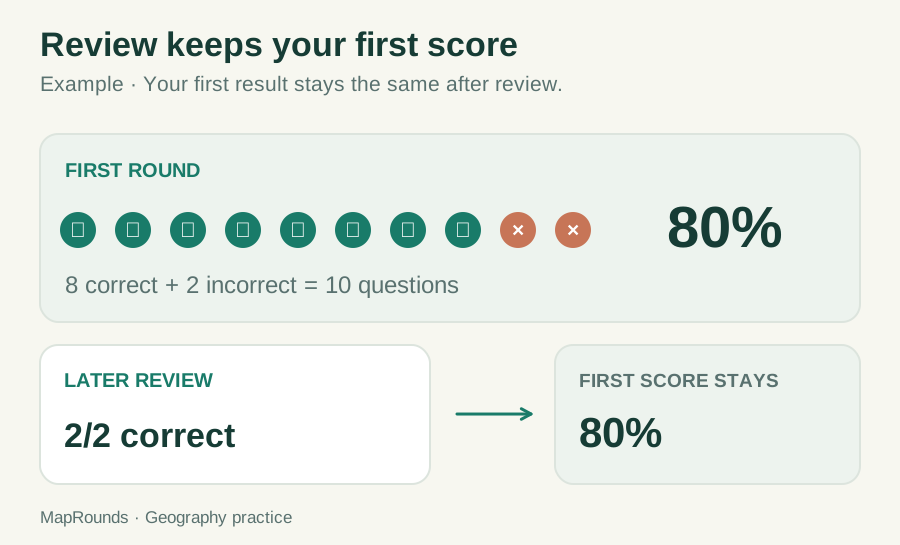
Eight correct answers and two incorrect answers make a ten-question round: 8 ÷ 10 × 100 = 80%. If you answer both missed questions correctly in review, review shows 2/2. The first-round score stays 80%.
Worked example: a skipped question
Seven correct, two incorrect and one skipped also make ten questions. The score is 7 ÷ 10 × 100 = 70%. Review includes all three missed questions: the two incorrect answers and the skipped one.
Review the questions you missed
- Complete the initial round and read its counts.
- Choose the missed-place review action when there are incorrect or skipped questions.
- Answer each review question. Read the correction, then choose Next review question.
- At the end, compare the review responses with the unchanged first-round score.
- Start a new round when you want a fresh initial attempt with its own result.
Review always uses the questions missed on the first attempt. Repeating it does not remove them from the original result. If your first round was perfect, there are no missed questions to review.
What timing changes
With Timer off, you can take as long as you need while the page remains open. With a time limit, unanswered questions become skipped when time is up. Keep the timing setting in mind when comparing results: an untimed round gives you different conditions from a timed one.
Check your understanding
- 1. A ten-question round has six correct, three incorrect and one skipped. What is the initial score?
- 2. How many questions from that example are eligible for mistake review?
- 3. After all review answers are correct, should the initial score become 100%?
Use the result to plan your next round
Start with the answers you missed and decide what to study next. Different rounds can draw different questions, so two scores are not identical tests. There is no public leaderboard or certificate. If a group shares one browser, the result belongs to that shared round.