Practice guide
Build a ten-minute geography practice routine
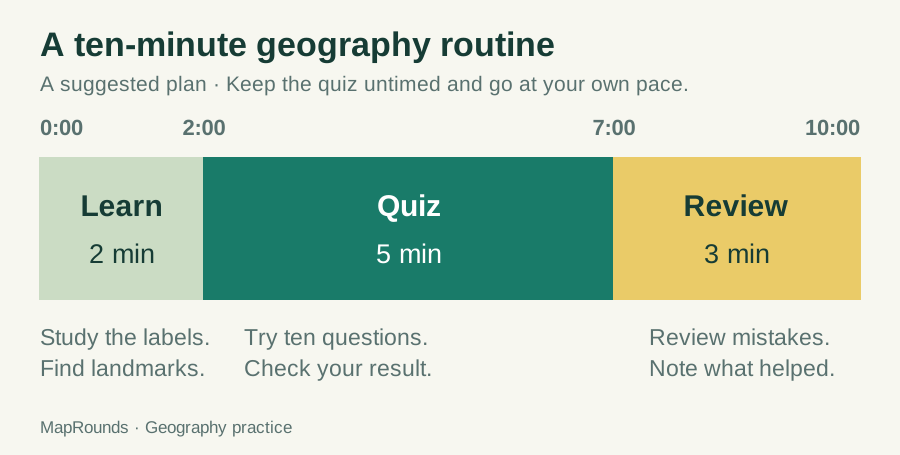
Pick one set and give yourself ten minutes: two to study, five to try a quiz and three to work on the places you missed.
On this page
Pick one quiz for today
Choose one task for the session: country locations, capitals or flags, for example. Open its included-place list so you know what it covers. You do not need to work through every region today. A small, clear task is easier to return to next time.
The example below uses Countries of Europe, ten questions and Timer off. The ten-minute plan is a suggestion for your session, not an app-enforced time limit. Use a separate clock if it helps, and finish the question you are on before moving to the next stage.
| Time | Action | Useful output |
|---|---|---|
| 0:00–2:00 | Learn with labels visible | Two or three location relationships you can explain |
| 2:00–7:00 | Play a ten-question round | An unchanged first-round result |
| 7:00–10:00 | Review incorrect and skipped answers | A short note about the specific confusion |
Minutes 0–2: learn a few anchors
In Learn, keep the labels on and look at a small group of neighboring countries. Try Estonia, Latvia and Lithuania from north to south, or choose a few shapes you already partly recognize. Look back and forth between each name and its position.
Before hiding the labels, ask yourself something specific: “Which of these three countries is in the middle?” Answer it, then check the map. A few clear relationships give you more to work with than a long list of names.
Minutes 2–7: try a ten-question round
Select Quiz, choose ten questions and leave the timer off. In the default map format, choose the name of the highlighted place. Read the feedback after each answer, then select Next question. Use Skip this question when you do not know the answer.
If you answer eight questions correctly and miss two, your first-round score is 8 ÷ 10 × 100 = 80%. Keep the number if you find it useful, but also notice which questions caused trouble. Your round draws random questions, so its places and result will differ from this example.
Minutes 7–10: work on what you missed
Open the missed-question review. If you confused Latvia and Lithuania, compare them on the map and say their north-to-south order before trying again. Answering both review questions correctly gives you 2/2 in review. The first-round result stays 80%, so you can still see what happened on your first attempt.
Finish with a short note, such as “I mixed up Latvia and Lithuania; Latvia is in the middle.” That tells you what to check next time. If you missed nothing, use the remaining time to explain a couple of your answers or try another set.
Comparing one session with another
- For a useful comparison, keep the quiz type, set and question count the same.
- Note whether you changed the timer or moved to a different kind of question.
- Expect some variation: two random ten-question rounds can ask about different places.
- Use the result to choose what to study next, rather than treating it as a complete measure of your geography knowledge.
Try the routine
Try this: you finish ten questions with seven correct, two incorrect and one skipped. What should you review, and what score should stay on screen? Review all three missed questions. The first-round result remains 70%, even if you get all three right in review.