Learn the map
Map scale calculator: convert map length and ground distance
A map scale compares two lengths in the same unit. Use the calculator to check a measurement, then follow the units to explain the result.
On this page
Try the method
Map scale distance calculator
Convert a measured map length to ground distance, or find the map length needed for a ground distance.
Enter your values, then choose Calculate.
Uses the stated 1 : n scale and standard unit conversions. Resizing a map changes its printed ratio. This is a flat map calculation; it does not account for terrain or projection distortion. MapRounds quiz maps are schematic and have no measurement scale.
Your entries stay in this page. No location permission, account or saved history is used.
What does a 1 : 25,000 scale mean?
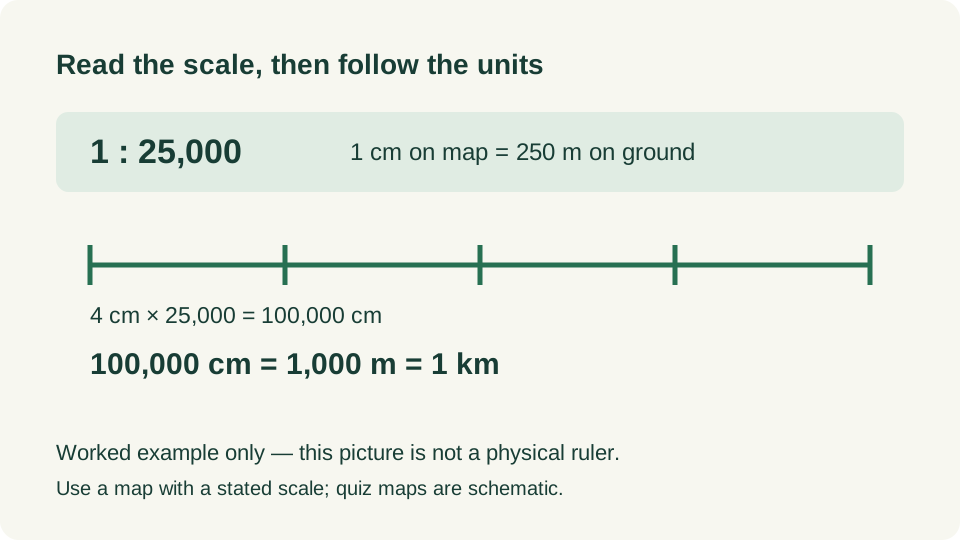
A ratio scale of 1 : 25,000 says that one unit on the map represents 25,000 of that same unit on the ground. One centimetre therefore represents 25,000 centimetres, or 250 metres. The number after the colon has no unit of its own. Never multiply centimetres by 25,000 and label the result kilometres without converting the units.
Calculate ground distance or work backwards
- Find the printed scale. Measure the line or a route broken into short segments; record the map unit.
- Multiply map length by the scale denominator to obtain ground length in the same unit.
- Convert to the requested ground unit. There are 100 cm in a metre and 1,000 metres in a kilometre.
- To work backwards, convert ground distance into the map unit first, then divide by the denominator.
| Task | Calculation | Result |
|---|---|---|
| 4 cm at 1 : 25,000 | 4 × 25,000 = 100,000 cm | 1 km |
| 32 mm at 1 : 50,000 | 32 × 50,000 = 1,600,000 mm | 1.6 km |
| Show 3 km at 1 : 50,000 | 300,000 cm ÷ 50,000 | 6 cm |
| 2 inches at 1 : 24,000 | 48,000 inches × 0.0254 metres per inch | 1,219.2 m |
Large scale means a smaller denominator
At 1 : 25,000 a feature appears twice as long as at 1 : 50,000 on equal-sized sheets. The former is the larger-scale map, even though 25,000 is the smaller denominator. A quick check is to compare the fractions 1/25,000 and 1/50,000. Choose a scale for the task: a local path and a whole-country overview need different coverage and detail.
Printing, screens and curved routes
A ratio written on a map applies at its intended size. If a map is enlarged to 200% of its original linear size, a printed 1 : 50,000 ratio now behaves as 1 : 25,000. A scale bar enlarged with the map retains its relation to the features. A ruler laid on an arbitrary screen zoom does not preserve the original printed ratio.
For a curved route, measure short connected sections and add them, or use a flexible line against the scale bar. This estimates the mapped route length; hills and surface conditions add other questions. Projection distortion can also vary across a map. This calculator only performs the stated length ratio and unit conversion. MapRounds quiz maps are schematic learning aids with no measurement scale, so do not use them to calculate travel distances.
Practice and check your answers
| Question | Answer |
|---|---|
| A line is 6 cm at 1 : 50,000. How far is it? | 3 km: 6 × 50,000 cm = 300,000 cm. |
| How long is 750 m at 1 : 25,000? | 3 cm: 75,000 cm ÷ 25,000. |
| Which shows a building larger, 1 : 10,000 or 1 : 100,000? | 1 : 10,000; the denominator is smaller. |
| Can a world-map screenshot give an exact walking distance? | No. Its scale, projection and route details need checking. |
Try a related quiz
Sources and further reading
Original MapRounds editorial text and diagrams: CC BY 4.0. Third-party source text and flag artwork retain their own terms; see the source and asset records.