Learn the map
Decimal degrees to DMS: coordinate converter and examples
Two coordinate formats can describe the same point. Convert the notation, keep the direction, and check the range before using the answer.
On this page
Try the method
Coordinate format converter
Convert decimal degrees to DMS, or enter degrees, minutes and seconds with a separate direction.
Enter your values, then choose Calculate.
Formatting rounds DMS to 0.01″ and decimal degrees to six places. This changes notation, not the datum or measurement accuracy. It does not locate a place or determine a time zone.
Your entries stay in this page. No location permission, account or saved history is used.
Decimal degrees and DMS describe the same angle
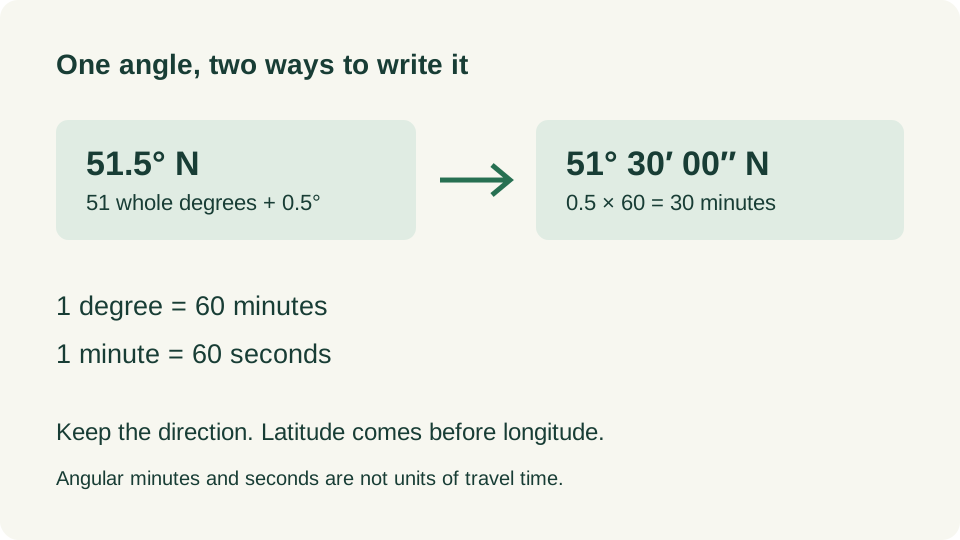
Decimal degrees write the fraction of a degree after a decimal point. DMS splits it into degrees (°), minutes (′) and seconds (″): 60 minutes make one degree, and 60 seconds make one minute. These are units of angle, not minutes and seconds of travel time. Keep latitude and longitude in their labelled fields; changing format never swaps their order.
How to convert by hand
- For decimal degrees → DMS, keep the absolute whole degrees. Multiply the remaining fraction by 60.
- Keep the whole minutes. Multiply their remaining fraction by 60 to get seconds.
- For DMS → decimal degrees, calculate degrees + minutes ÷ 60 + seconds ÷ 3600.
- Apply the direction to the entire result: south and west are negative; north and east are positive.
| Input | Working | Equivalent |
|---|---|---|
| −0.125° longitude | 0.125 × 60 = 7.5; 0.5 × 60 = 30 | 0° 7′ 30″ W |
| 12° 30′ 36″ S | 12 + 30/60 + 36/3600 = 12.51 | −12.51° latitude |
| 45.75° latitude | 0.75 × 60 = 45 | 45° 45′ 00″ N |
Check signs, limits and rounding
Use one direction system at a time. Enter −12.51 in the decimal field, or 12 degrees with S in the DMS form. Do not enter a negative degree and S together. Latitude ranges from −90° to 90°; longitude from −180° to 180°. At 90° latitude or 180° longitude, extra minutes or seconds would exceed the range. Minutes must be whole numbers below 60, and seconds must be below 60.
Rounding 59.999 seconds to two decimal places gives 60.00, so carry one minute rather than displaying an invalid seconds field. A value just below a degree boundary may therefore round to the next degree. The converter preserves a negative-zero direction, but 0° N and 0° S denote the same latitude; likewise 0° E and 0° W. At either pole, longitude does not distinguish different points. At 180°, east and west meet.
Practice and check your answers
| Try before calculating | Answer and reason |
|---|---|
| Convert 23.25° N to DMS. | 23° 15′ 00″ N: a quarter of a degree is 15 minutes. |
| Convert 73° 45′ 30″ W to decimal degrees. | −73.758333° to six decimal places; the whole magnitude is west. |
| Is 90° 0′ 1″ N valid? | No. It passes the latitude limit. |
| Is 8° 60′ 0″ E valid input? | Normalize it to 9° 0′ 0″ E before entering; the minutes field must be below 60. |
What the converter cannot tell you
A notation conversion does not transform between datums, locate a country, or improve the original measurement. Extra decimal places are display precision, not proof of accuracy. Degrees and decimal minutes is a third format: 51° 30.5′ is not 51° 30′ 5″. Use the latitude and longitude introduction for reading the grid, then apply that understanding in a world map quiz.
Try a related quiz
Sources and further reading
Original MapRounds editorial text and diagrams: CC BY 4.0. Third-party source text and flag artwork retain their own terms; see the source and asset records.